
Texas District Courts Explained
Texas does not run one trial court. It runs several, and the district court sits near the top of the trial level. District courts are the state's courts of general jurisdiction. They hear the biggest cases. In Bexar County that means felonies, large civil suits, divorce and family matters, and juvenile cases.
Each district court carries a number. The number is a holdover from the order each court was created across Texas. So Bexar County has courts like the 37th, the 144th, and the 438th. The low numbers are old. The high numbers are newer. The number does not tell you the case type by itself, but local rules group the courts into civil, criminal, juvenile, and family dockets.
The District Clerk is the official custodian for civil district court records and felony criminal records in Bexar County. So the court hears the case, but the clerk keeps the file. To read or copy a district court record, you work with the Bexar County District Clerk. To find a case online first, use Bexar County court records on the Justice Portal.
Note: The district court decides the case, but the District Clerk holds the file, so certified copies of felony and civil district records come from the clerk.
Bexar County District Court List
The county publishes a full roster of numbered district courts. Each row shows the court, the sitting judge, and a direct phone. Use it to match a case to the right court before you call. The table below reproduces that official list, from the Fourth Administrative Judicial Region down through the 438th.
| Court | Judge | Phone |
|---|---|---|
| 4th Administrative Judicial Region | Judge Sid Harle | 210-335-0466 |
| 37th Civil District Court | Judge Nicole Garza | 210-335-2515 |
| 45th Civil District Court | Judge Mary Lou Alvarez | 210-335-2507 |
| 57th Civil District Court | Judge Antonia Arteaga | 210-335-2531 |
| 73rd Civil District Court | Judge Elizabeth Martinez | 210-335-2523 |
| 131st Civil District Court | Judge Norma Gonzales | 210-335-2514 |
| 144th Criminal District Court | Judge Michael Mery | 210-335-2511 |
| 150th Civil District Court | Judge Monique Diaz | 210-335-2533 |
| 166th Civil District Court | Judge Laura Salinas | 210-335-2501 |
| 175th Criminal District Court | Judge Catherine Torres-Stahl | 210-335-2527 |
| 186th Criminal District Court | Judge Kristina Escalona | 210-335-2505 |
| 187th Criminal District Court | Judge Stephanie R. Boyd | 210-335-2517 |
| 224th Civil District Court | Judge Marisa Flores | 210-335-2132 |
| 225th Civil District Court | Judge Christine Vasquez-Hortick | 210-335-2233 |
| 226th Criminal District Court | Judge Benjamin Robertson | 210-335-2446 |
| 227th Criminal District Court | Judge Christine Del Prado | 210-335-2304 |
| 285th Civil District Court | Judge Nadine Melissa Nieto | 210-335-2086 |
| 288th Civil District Court | Judge Cynthia Marie Chapa | 210-335-2663 |
| 289th Juvenile District Court | Judge Rose Sosa | 210-335-1185 |
| 290th Criminal District Court | Judge Jennifer Pena | 210-335-2696 |
| 379th Criminal District Court | Judge Ron Rangel | 210-335-2911 |
| 386th Juvenile District Court | Judge Jacqueline Valdes | 210-335-1155 |
| 399th Criminal District Court | Judge Frank J. Castro | 210-335-3638 |
| 407th Civil District Court | Judge Tina Torres | 210-335-2462 |
| 408th Civil District Court | Judge Angelica Jimenez | 210-335-2831 |
| 436th Juvenile District Court | Judge William "Cruz" Shaw | 210-335-1194 |
| 437th Criminal District Court | Judge Joel Perez | 210-335-2711 |
| 438th Civil District Court | Judge Rosie Alvarado | 210-335-0448 |
Phone numbers and judges can change after an election. Confirm the court before you rely on a listing. The Bexar County court dockets page shows how to search hearings by court and judge.
Civil, Criminal, Family, and Juvenile Courts
Bexar County groups its district courts by case type. The names in the list above hint at the split. Civil district courts hear money disputes, contract suits, property claims, injunctions, name changes, and expunctions. Criminal district courts hear felony cases, from drug charges and theft to assault and murder. Family and juvenile work runs through specific courts too.
Divorce, custody, child support, paternity, and adoption are family matters. They are district court cases in Texas, and the file lives with the District Clerk. That is why a divorce points to the District Clerk and not the County Clerk. For the steps, see Bexar County divorce records.
Juvenile cases go to the 289th, 386th, and 436th Juvenile District Courts. These files are not open like adult cases. Texas law treats juvenile records as confidential. The same goes for adoption and many child-welfare matters. A felony record, though, is generally open and runs through Bexar County criminal records.
The county courts portal also lists specialty calendars under both civil and criminal courts. Family Drug Court sits under the civil district courts. Felony Drug Court and Felony Veterans Treatment Court sit under the criminal district courts.
District Court vs County Court vs Justice Court
It helps to see the three trial levels side by side. Each court handles a different slice of cases, and each sends its records to a different custodian. The table below lays out the main differences for Bexar County.
| Feature | District Court | County Court at Law | Justice Court |
|---|---|---|---|
| Case types | Felonies, large civil, family, juvenile | Misdemeanors, county civil, lower-court appeals | Small claims, evictions, Class C citations |
| Jurisdiction | General trial court | County-level court | Precinct court |
| Where records live | District Clerk | County Clerk | Justice of the peace precinct |
For more on the middle tier, see the Bexar County Courts at Law page. For the precinct courts, see the Justice of the Peace page.
Appeals From Bexar County District Court
A district court ruling is not always the last word. A party can appeal. Most appeals from Bexar County go to the Fourth Court of Appeals, which sits right in San Antonio. That court is the intermediate appellate court for the region.
From there the path splits by case type. Civil appeals can move up to the Supreme Court of Texas. Criminal appeals move up to the Texas Court of Criminal Appeals. Texas is one of two states with two separate high courts, one for civil and one for criminal. The flow below shows the usual climb.
Case flow: Justice Court › County Court at Law › District Court › Fourth Court of Appeals › Supreme Court of Texas / Court of Criminal Appeals
Not every case starts at the bottom. A felony begins in district court. A small claim begins in a justice court. The flow shows the appeal route, not a path every case must walk start to finish.
Bexar County Specialty District Court Programs
Bexar County runs several problem-solving courts. These programs try to treat the root cause behind a case, not just punish. The courts portal lists Family Drug Court, Felony Drug Court, Felony Veterans Treatment Court, Prostitution Court, and Mental Health Court, plus calendars such as Felony Impact Court.
Felony Drug Court sits under the criminal district courts. It targets felony defendants whose cases tie back to substance use. Felony Veterans Treatment Court serves veterans with felony cases, linking them to treatment and veteran support. The official program rules and judges for these two tracks were not fully posted, so confirm the current terms with the court before you count on them.
The county lists each track on one page. The screenshot below comes from the Bexar County Specialty Courts page.
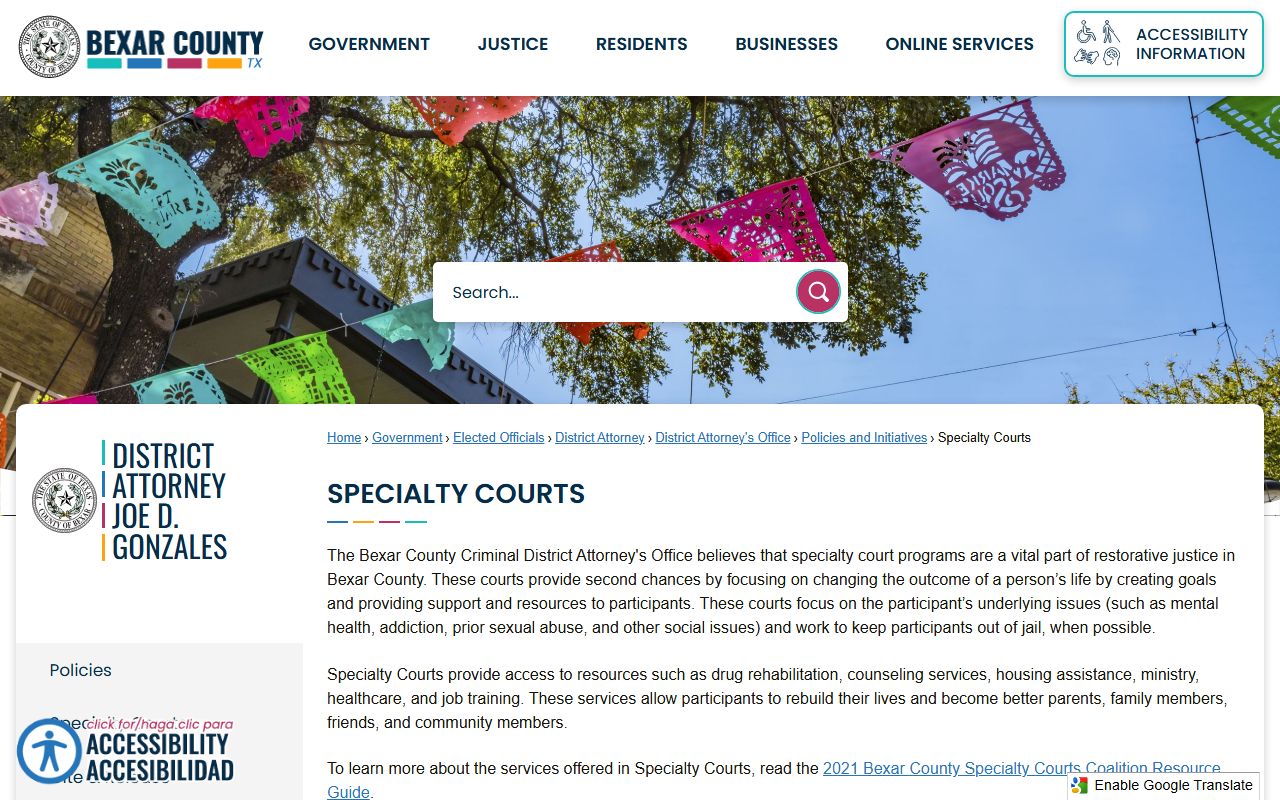
That page is the official landing point for the problem-solving calendars. Use it to find the right track and the right contact.
Note: Specialty courts are voluntary diversion programs, so a defendant usually must qualify and agree to the terms before a case moves onto one of these calendars.
Bexar County Mental Health Court
Bexar County runs two mental health courts. They serve different needs. The criminal Mental Health Court helps people with mental illness who have an active case. The civil Mental Health Court, under Probate Court No. 1, handles commitment hearings.
The criminal track serves Bexar County residents who are at least 18, have an active misdemeanor case, and carry a qualifying diagnosis. The list of diagnoses includes major depressive disorder, bipolar disorder, schizophrenia, schizoaffective disorder, and anxiety disorder. The court's mission is to link people to treatment and community support and to cut repeat involvement in the justice system.
The civil side runs probable cause and commitment hearings at the San Antonio State Hospital. Probable cause hearings are Monday and Thursday at 9:30 AM. Commitment hearings are Tuesday at 9:30 AM. Because these cases hold medical data, the records are restricted from public view.
The screenshot below is from the county's Mental Health Court page.
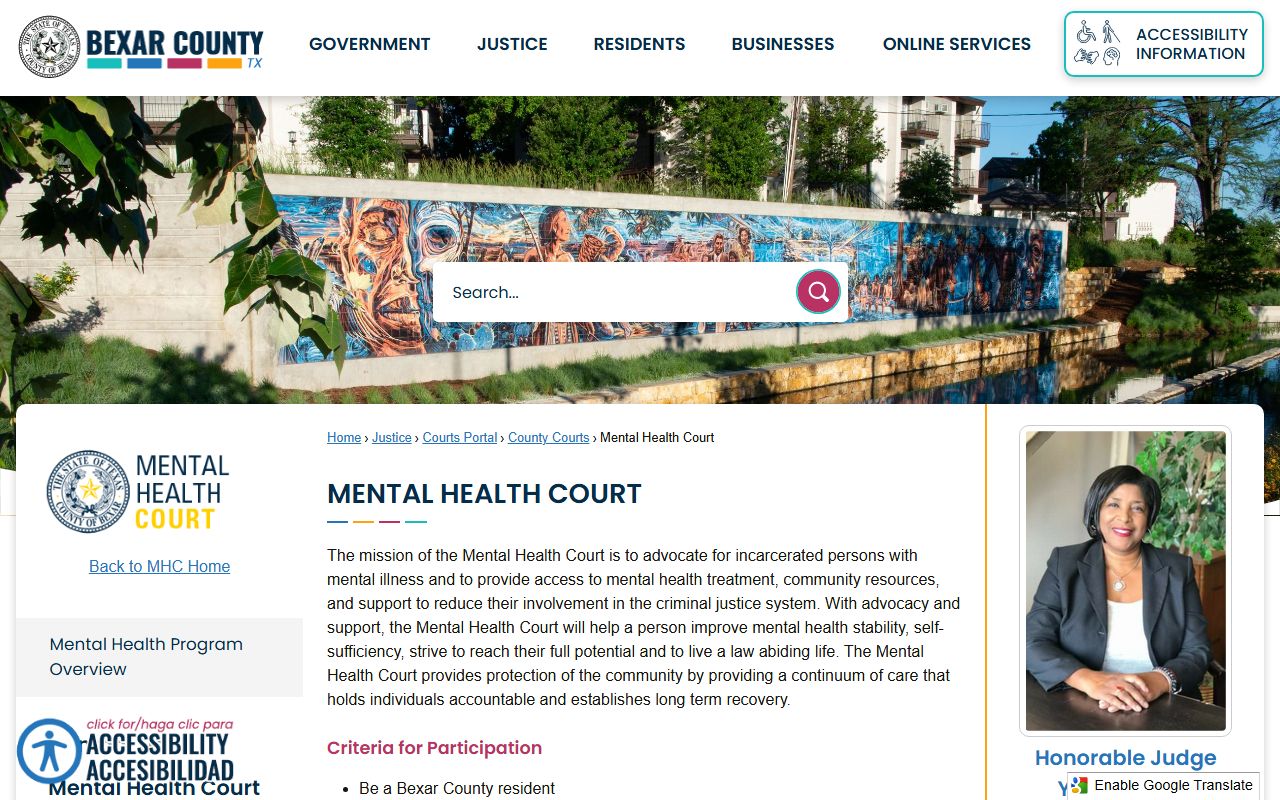
That page lists the mission, the eligibility rules, and the contacts for the criminal mental health track.
Where Bexar County District Court Records Live
The custodian rule is simple once you know it. The District Clerk keeps the files the district courts make. That covers felony criminal records and civil district records, including family cases like divorce. The County Clerk does not hold these.
You can find a case online first. The Justice Portal pulls district court cases into Smart Search. Search by name in Last, First Middle order, or by case number. Then, if you need a stamped copy for court, order a certified copy from the District Clerk. A certified copy carries the clerk's seal and is accepted as official.
- Felony criminal files - District Clerk; indictments, pleas, judgments, and sentencing.
- Civil district files - District Clerk; petitions, motions, orders, and judgments.
- Family and divorce files - District Clerk; divorce, custody, support, and paternity.
- Juvenile files - confidential; access is limited by Texas law.
The District Clerk does not take personal checks. Cash, money orders, cashier's checks, and major cards work. For the broader record picture, see Bexar County court records.
Bexar County District Court Locations
The court campus spreads across several downtown buildings. The historic Bexar County Courthouse stands at 100 Dolorosa. District Clerk civil records and felony filing run from the Paul Elizondo Tower at 101 W. Nueva Street. Because counters sit in different buildings, confirm yours before you park.
The historic courthouse holds courtrooms and county offices. The detention center and Central Magistration sit a few blocks away at 200 N. Comal Street.
History of the Bexar County Courthouse
The current Bexar County Courthouse is a landmark. The county calls it the largest and oldest continuously operated historic courthouse in Texas. It is the fifth seat of county government, after buildings under Spain, Mexico, the Republic of Texas, the Confederacy, and the United States. The four older buildings all stood within two blocks of the current one.
Architect James Riely Gordon designed it in Romanesque Revival style. The cornerstone was laid in 1892, and the county lists completion in 1897; the Texas Historical Commission lists 1896. Crews used native Texas granite and red sandstone, with green and red tile roofing. Later additions came in 1914, 1927, 1963, and 1972.
A master plan led crews to remove the 1963 and 1972 additions. The restoration returned the building to its 1927 look by spring 2015. Workers restored the two-story courtroom, coffered ceilings, gilded plaster, and windows that echo the rose window at Mission San Jose. The courthouse was rededicated on July 14, 2015.
The screenshot below comes from the Texas Historical Commission courthouse page.

That page covers the design, the restoration work, and the building's landmark status.
Funding for Bexar County District Courts
The courts run on a county budget. Bexar County Commissioners Court adopts that budget each year. The plan funds court staff, the clerks, the jail, and the many programs tied to the courts. The county posts each adopted budget for the public to read.
You do not need budget numbers to search a case. But the documents show how the court system is paid for and how the specialty programs get support. The screenshot below comes from the county's Adopted County Budgets page.
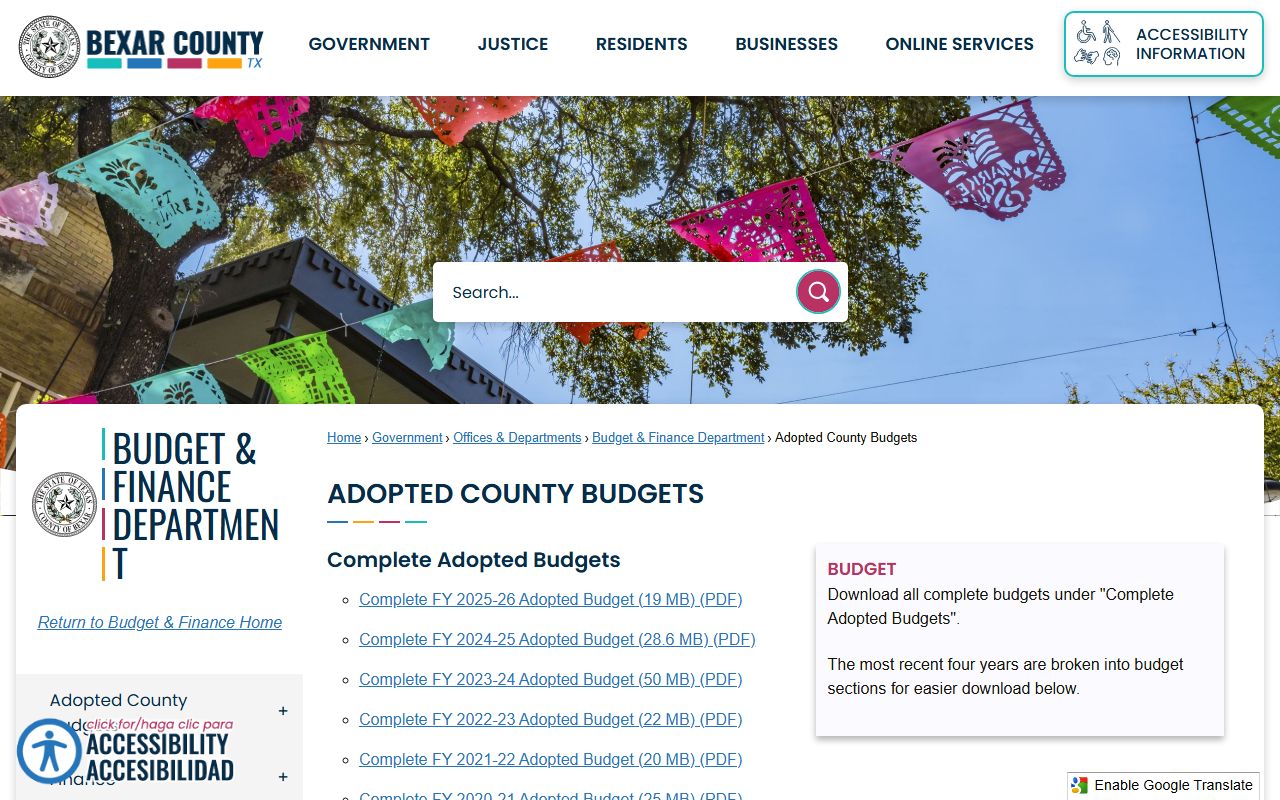
That page lists the budget by year, so you can see how court funding has shifted over time.